


Pan-Fried Fish with Gremolata
Quick Recipes Simple Recipes Fish and Seafood Gluten-Free Recipes Sauces and Salsa
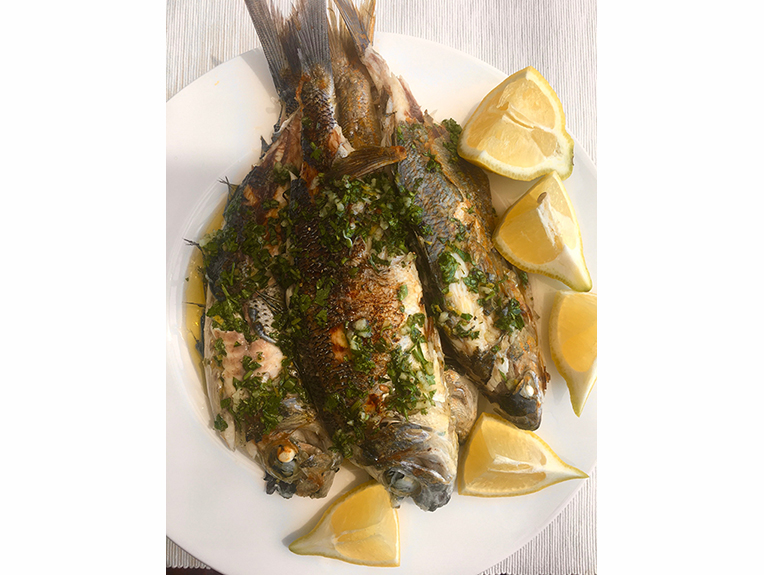
If you followed me on Instagram you already know that during this seaside vacation I cooked. This for two reasons. Covid, obviously, we tried to keep our distance as much as possible, even though Croatia didn't have a high number of infections. Secondly, the super-equipped kitchen of the rented apartment. It simply tempted me to cook every day.
I preferred to go with simple recipes using fresh ingredients from the local market, that's how I think it's normal to cook in summer even at home. The simplest sauce for fish is gremolata. You can make it just with a knife and a microplane. At home I use a mortar for the garlic, but on vacation a grater is enough. With it you grate both the lemon zest and the garlic. Mix everything with oil and the sauce is ready! The sauce is super fresh, it gives a kick to any piece of grilled meat, especially fish, shrimp, calamari, but I've also used it for veal, chicken or steak. It's also ideal for finishing soups or stews as you can see in this recipe for ossobuco milanese.
Essentials packed because I didn't know what the kitchen was equipped with: a wide pan with a thick bottom, two knives (one large for chopping/cutting, one small for peeling vegetables), a microplane. Having a few infused oils handy (lemon, chili, basil) doesn't hurt, at home too, not just on vacation. In cases where you can't find organic lemon or don't have fresh basil... these oils are lifesavers. With them you can cook simply and well on vacation.
Ingredients
2-4 small fish (sea bream for example; 4 if they're around 200-300g; 2 if over 350g)
salt
a little oil for coating
a little lemon-infused oil for finishing
Gremolata
1/2 bunch parsley
1 garlic clove
1 small organic lemon
5-6 tablespoons extra virgin olive oil
salt
Servings: 2
How to prepare pan-fried fish with gremolata
- Crush the garlic and rub it in a mortar with a little salt until it becomes a paste. Finely chop the parsley and grate the lemon zest over it. Continue chopping, running the knife over the parsley several times until it's very finely minced. Add the oil and mix with a spoon, don't crush with the pestle anymore.
* if you don't have a mortar, grate the garlic on the fine lemon grater (microplane), it will come out pasty enough - Pat the cleaned fish dry with paper towels. Sprinkle with salt all over, including inside. Then coat with a little oil all over, just enough so they don't stick to the pan.
- Heat a wide pan well (ideally non-stick) that fits the fish (around 30 cm diameter). Place the fish in the pan and let them cook on the first side for 3 minutes. Flip and let them cook another 3 minutes on the second side, this time with a lid if you have one. Be careful when flipping so they don't break, use a spatula. If the skin sticks a little to the pan don't stress (depends on the pan), they won't look bad in the end. If the fish are under 300g they're now done. If larger, repeat the flipping once more to cook 3 more minutes on each side. If the pan is cast iron or has a thick bottom that retains heat well, the fish will brown more nicely.
- Remove the pan from heat and add half the gremolata over the fish, trying to take more oil. Shake the pan with back-and-forth motions to distribute the sauce among the fish. Tilt the pan and with a spoon baste the fish with the sauce that has formed underneath. The sauce will cook gently from the pan's heat and will smell wonderful, it will permeate the fish. Don't rush, repeat the basting several times.
- Remove the fish to a platter and drizzle with a little lemon-infused oil (a vacation trick 😉) or a little extra virgin olive oil if you don't have the lemon one.
- Serve the fish with the remaining gremolata alongside and lemon wedges.