How to Cook Dried Beans
Ingredients
dried beans
herbs and vegetables
water
salt
How to prepare how to cook dried beans
- Cooking time for dried beans varies greatly: from 45 minutes to 2-3 hours. This time depends on the size and variety of the beans. It also depends on the quality of the water in which you cook the beans. The age of the beans has a big impact. A 1-year-old dried bean will cook faster than a 3-year-old one. Ideally, you should use beans that are not older than 2 years.
However, when you buy beans from grocery stores, you do not know exactly how old they are. I obviously recommend buying beans from a trusted source (from the market or from the countryside) because you can ask how old the beans are and sometimes you can find out the approximate cooking time for them. And when you find a good source, try to always buy from there. You can buy a larger quantity at once, because they last a long time in a cool pantry (under 20C).
This way you can also avoid the situation where the same package contains beans from different years. This is the worst situation because some beans will cook faster than others. And by the time the older beans are cooked, the fresher ones will be mushy. What can you do with them in this case? Mashed beans, bean spread... any recipe where the beans do not need to remain whole.
Tip: for each new batch of beans, after the first cooking, note on the bag/package the cooking time so you know it next time you cook from it.
And now let us move on to the actual cooking steps. - Put the dried beans in a large bowl and cover with plenty of lukewarm water. Let them soak overnight (minimum 8 hours). This step reduces cooking time. It has a big effect especially for 1-2 year old dried beans. If you need to keep the beans soaking for more than 10 hours, then put the bowl in the refrigerator so they do not ferment.
- The next day you will see that the beans have swelled. Collect and discard all the beans that float on top of the bowl. Drain the water from the beans and rinse the beans with cold water. By discarding the soaking water, you reduce the gas caused by beans. Soaking also reduces the risk of the beans cracking during cooking.
Squeeze a bean between your fingers. If you feel it is softer, it will cook faster than if you feel it does not give at all under pressure. - Put the beans in a pot and add water to cover them by 4-5 cm. Bring to a boil over medium heat.
You can add baking soda to the water (1/4 teaspoon per 500 g dried beans) if you want the beans and their skin to soften better (for example if you are going to make mashed beans). This way, when you mash them, they will be creamier. However, baking soda will destroy some vitamins, so do not overuse it. - When it starts to boil, turn the heat to low, so that the water just gently simmers. Put the lid half on. Why not cook beans over high heat? Because after the beans soften, if they boil and bump into each other in the pot, they will easily fall apart. So low heat so the beans do not break and the skin does not crack.
- In the first part of cooking, stir the beans occasionally to make sure they cook evenly, especially if you are cooking a larger quantity. Stirring every 15-20 minutes is fine. However, when the beans start to soften, do not stir anymore, so you do not break them.
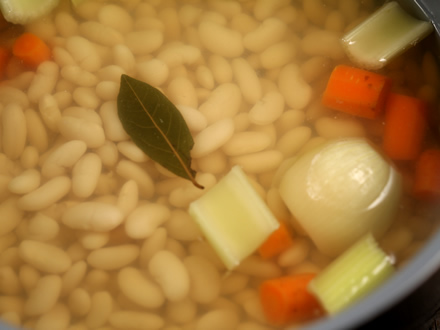
- Cook the beans until fully or partially done. Start checking after 30 minutes. Taste 2-3 beans and see how they are. When you feel the bean slightly floury (a sign that it is almost cooked), add salt. How much salt? Add gradually and taste the water, when it tastes pleasantly salty it is fine. Now add other aromatics if desired: carrot, celery stalk or root, whole onion, whole garlic cloves, bay leaf, thyme, parsley.
Just before adding the salt, if you see shriveled bean beans floating on top, pick them up with a slotted spoon and discard them.
If during cooking the water drops a lot and you need to top up, always add boiling water, not cold. - If you are going to make bean soup or use them in salads, cook until fully done, but without becoming crumbly/mushy. However, if you are going to make iahnie or baked beans, the beans should be cooked a bit less because they will continue to cook with the sauce. In this case, stop when the beans are cooked but you still feel a small grain in the center that needs to be crunched.
- Turn off the heat. The beans can be used immediately, but it is preferable not to take them out boiling hot from the water they cooked in, the skin will "bloom" and look ugly. Let them cool down a bit before draining.
If you will not use them immediately, let them cool completely in the water they cooked in. They keep in the refrigerator for a maximum of 4 days, stored in the cooking water. In general, I prefer to cook them a day before because the liquid from them thickens, becomes somehow viscous and thus the dish will have a nicer texture. Also, the taste and texture of the bean will improve. Beans cooked a day before are especially good for iahnie, soup or when you make them baked, that is, in any recipe where you will use the liquid from them. With that viscous liquid, the dish will thicken naturally and will not need (or will need less) roux.
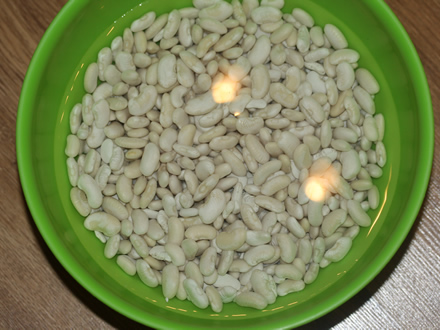
Beans soaked overnight (I discarded the floating beans)
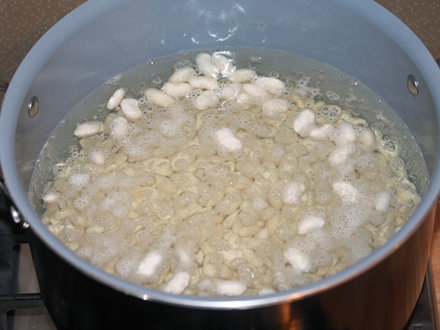
Starting to boil, lower the heat and put the lid half on
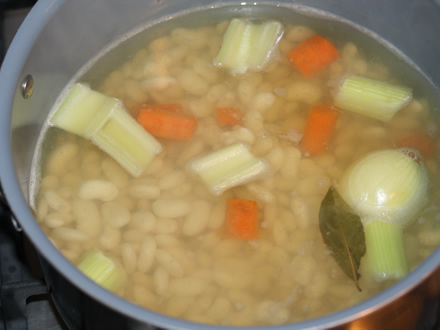
When more than half cooked, collect floating beans and add salt and aromatics
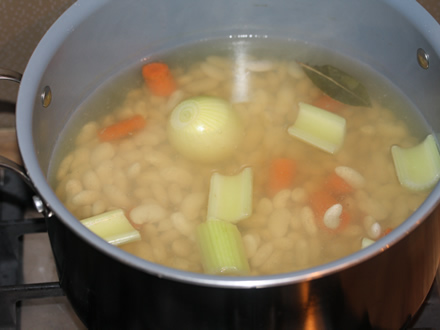
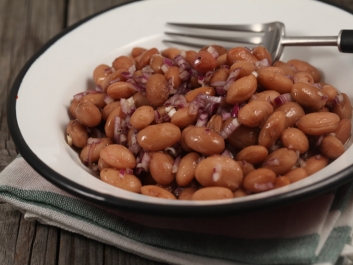
Dried beans are cooked